A consortium of technology centers and Navarre companies will develop high-performance biopolymers for the biomedical sector from agri-food by-products.
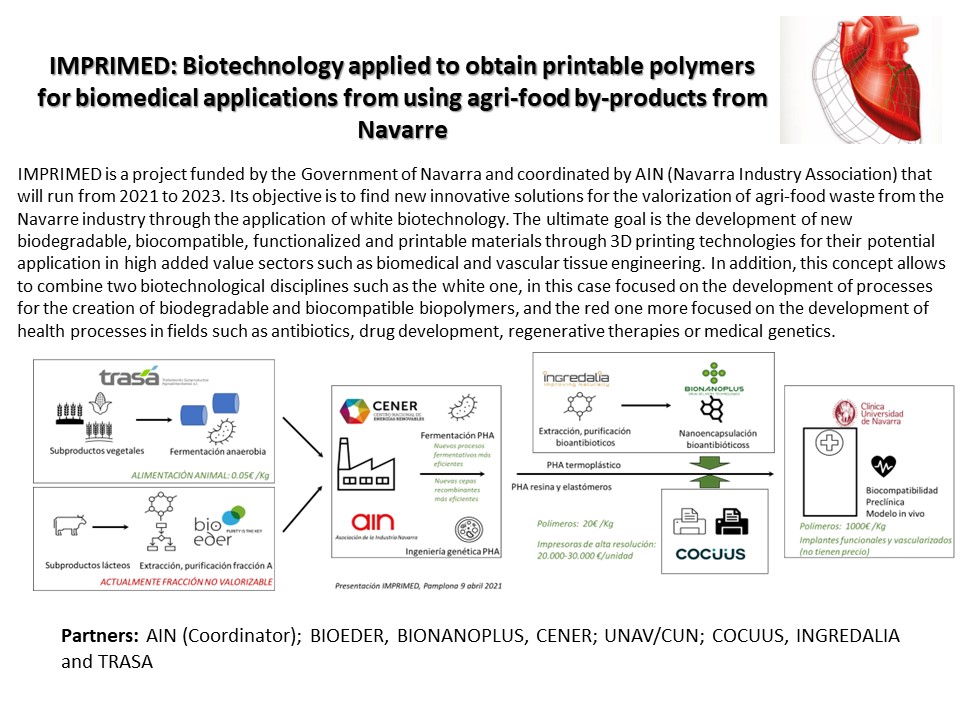
AIN, CUN, and CENER, together with TRASA, Ingredalia, Cocuus, Bioeder, and Bionanoplus, are working together on the IMPRIMED project funded by the Government of Navarre.
Aligned with the Smart Specialization Strategy (S3), it strengthens Navarre’s position in the field of personalized medicine and the circular economy.
Cordovilla, May xx, 2022
The Association of Navarre Industry (AIN), the University of Navarre Clinic (CUN), and the National Renewable Energy Center CENER, together with the companies TRASA (Agri-Food By-Products Treatment), Ingredalia, Cocuus, Bioeder, and Bionanoplus, are working jointly on the IMPRIMED project funded by the Government of Navarre under the 2021 call for strategic R projects. This consortium will investigate over the next two years how to produce, from agri-food by-products, a new family of biopolymers that can be used in high-value-added applications, particularly in 3D printing applications in the biomedical sector. In fact, one of the project’s most ambitious objectives is to study the printing of biocompatible and bioabsorbable cardiovascular implant prototypes from the biomaterials developed in the project.
The project, which brings together two key sectors of Navarre’s Smart Specialization Strategy (S3)—health and agri-industry—is led by the Association of Navarre Industry.
AIN explains that, within the circular economy framework, the agri-food industry becomes an economically affordable source of raw materials for biopolymer production: “Biopolymers are materials that, due to their biocompatibility, biodegradability, and potential mechanical properties similar to human cardiac tissue, make them an ideal candidate for this type of biomedical application,” describe Drs. Saioa Burgui and Mariola Calle, researchers responsible for this project at AIN.
However, to make the valorization of agri-food by-products and the promotion of a circular economy a reality, it is necessary to structure a value chain from companies that valorize agri-food by-products to companies that develop bioprinting technology. This is one of the notable aspects that IMPRIMED has achieved, with the participation of TRASA and Bioeder for the study and preparation of the by-products they manage into new valuable fractions; Bionanoplus and Ingredalia to develop new natural-origin alternatives to synthetic bactericidal substances that can be incorporated into the new biomedical implants through nanotechnology; and finally the company Cocuus, which will develop the new bioprinters that will enable it to enter the tissue bioprinting sector in healthcare.
IMPRIMED also has the participation of 3 complementary SINAI agents (AIN, CENER, and CUN) that support the companies to ensure that this transformation of by-products into high-performance bioplastics can take place. Thus, CENER and AIN will work on developing more sustainable biotechnological processes to transform by-products into printable materials, ensuring technology transfer to companies. In this way, the Advanced Materials group at AIN will develop new genetic engineering tools to transform agri-food by-products into biopolymers compatible with the human body in a more efficient and competitive manner. Additionally, in later phases, materials will be developed to ensure they can be printable and processable at a pre-industrial scale. Furthermore, CENER will facilitate effective implementation at a larger production scale. Finally, the new biopolymers will be validated by CUN through the generation of vascularized human cardiac tissue in the form of demonstrators printed from the new materials and human vascular cells.
In summary, on one hand, biotechnology and especially the bioeconomy based on the use of renewable resources constitutes one of the two main pillars of IMPRIMED and is undoubtedly a strategic sector in the economic recovery in the current scenario focused on ecological transition and the circular economy, in which Navarre is making a significant effort. The IMPRIMED project will undoubtedly contribute to boosting the biotechnology sector in the region, promoting new business and industrial exploitation opportunities, as well as internationalization and R collaboration. On the other hand, the advantage of developing and validating new bioprinting techniques within the Navarre community will allow the region to position itself in the market for these technologies, streamlining and boosting its research activity in regenerative medicine, tissue engineering, and also in the field of biomaterials science through the creation of new market opportunities for the valorization of agri-food by-products.
 Descubre